Sustainable and ethical matcha is not a single grade, seal, or farming method. It is the result of choices across cultivation, harvest, processing, labor, packing, and transport. No tin has zero impact, and a vivid green color says nothing by itself about worker welfare, pesticide use, soil health, or packaging waste.
A credible seller should help buyers trace important claims to named standards, documented practices, or a producer with a clear location. This guide explains what to ask, what common labels cover, and where their limits begin. It treats sustainability as a set of trade-offs rather than a marketing adjective.
Farming and shade: where matcha begins
Matcha is made from tencha, tea leaf grown under shade before harvest, then steamed, dried, refined, and milled. Shade is central to matcha character because reduced light changes leaf growth and chemistry. Yet shade systems also require materials, installation, maintenance, and labor. Traditional reed or straw coverings and modern synthetic shade cloth have different service lives, costs, and end-of-life problems. Neither is automatically best in every setting.
Ask how long shading materials remain in use, whether plastic cloth is repaired or replaced, and what happens when it wears out. A producer who explains a system, including its drawbacks, gives more useful evidence than a seller who calls all shade growing “traditional” or “eco-friendly.” Farm scale, slope, local weather, cultivar, harvest schedule, and quality target all affect the practical choice.
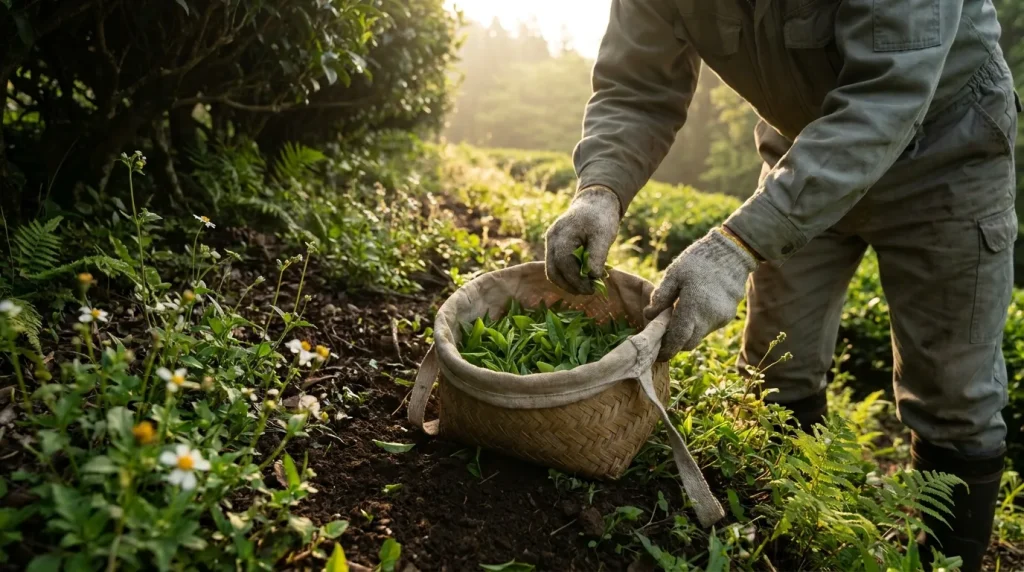
Harvest method matters too, but simple moral rankings mislead. Hand picking can select tender leaves and support skilled seasonal work, while machine harvesting can reduce cost and make production viable where labor is scarce. Ethical assessment depends on pay, hours, safety, contracts, and worker voice, not on whether a product page romanticizes hand labor.
Fertilizer, pesticides, water, and energy
Tea is a perennial crop, and farmers manage nutrients, weeds, insects, disease, and moisture over many seasons. Organic rules restrict many synthetic fertilizers and pesticides, but organic farms still use approved inputs. Conventional does not necessarily mean careless, and organic does not prove low emissions, rich biodiversity, fair pay, or good water management.
Useful questions concern practice and measurement. Does the farm test soil before applying nutrients? Does it use compost, cover crops, mulches, slow-release sources, or split applications to reduce loss? Are pests monitored before treatment? Does the producer use integrated pest management, biological controls, resistant cultivars, or habitat for beneficial species? Are application records kept, and are workers trained and given suitable protective equipment?
Processing also consumes energy. Fresh leaves are steamed to stop oxidation, then dried, sorted, stored cold, and eventually milled. Sellers rarely have a complete product carbon footprint, so buyers should not demand false precision. They can ask whether a producer measures electricity or fuel use, has efficiency targets, uses renewable power, or consolidates cold storage and milling. Specific improvement data is stronger than an unsupported “carbon neutral” badge.
Soil health and biodiversity
Healthy soil supports tea plants, stores water, cycles nutrients, and resists erosion. Relevant practices may include permanent ground cover between rows, contour management on slopes, compost, reduced soil disturbance, buffer strips beside waterways, and careful drainage. Results depend on place. Dense ground cover can protect soil but may compete for water or shelter pests, so management and monitoring matter.
Biodiversity claims need a defined scale. A farm may protect hedges, woodland edges, streams, pollinator habitat, or uncultivated patches while still operating a tea monoculture in production rows. Ask what habitat is protected, how much land it covers, and whether the claim concerns the farm, a cooperative, or a wider landscape. “Biodiversity friendly” without a species survey, habitat plan, or named practice is too vague to compare.
Labor, purchasing relationships, and traceability
An ethical matcha claim should extend beyond the farm owner. Tea production may involve permanent staff, seasonal pickers, machinery operators, tencha processors, mill workers, packers, and subcontractors. Buyers cannot infer conditions from Japanese origin, family ownership, or a photograph of a farmer.
Look for information about written contracts, legal wages and hours, overtime, occupational safety, pesticide training, grievance channels, freedom from forced and child labor, and whether seasonal or migrant workers receive equivalent protection. A certification audit can add oversight, but it is not a guarantee that every problem is found or fixed.
Traceability makes claims testable. Strong product information names the country, prefecture or region, producer or cooperative where possible, harvest or milling period, and certifier when a certified claim appears. Lot codes connect a tin to purchasing and processing records. Blends can still be responsible products, but sellers should state that they are blends rather than implying single-estate provenance.
Longer purchasing relationships may give producers more predictable demand and room to invest, but “direct trade” has no universal legal definition. Ask what direct means: who contracts with whom, how often buyers visit, whether intermediaries remain involved, how prices are set, and whether commitments span more than one harvest. Intermediaries can provide logistics, quality control, finance, and translation. Their presence alone does not make a chain unethical.
What certifications prove, and what they do not
Certification can turn selected claims into auditable requirements. Scope matters. Japan’s Organic JAS system governs organic labeling for qualifying agricultural products. Imported products sold as organic may also need to meet rules in the destination market. Fairtrade standards address social, economic, and environmental requirements in covered supply chains. Rainforest Alliance certification uses its own farm and chain-of-custody requirements. Each system has eligibility rules, audits, records, fees, and defined claims.
No single seal answers every question. Organic certification focuses on production and handling rules, not a complete life-cycle assessment or proof of living wages. Social certification cannot make shipping emissions disappear. Certification may be too costly or administratively heavy for some small producers, while an uncertified claim may be sincere but harder for a buyer to verify.
| Claim | Useful evidence | Limit to remember |
|---|---|---|
| Organic | Named certifier, certification number or searchable listing, market-specific organic mark | Does not by itself prove fair wages, low carbon impact, or biodiversity gains |
| Direct trade | Named producer, relationship length, purchasing process, price-setting explanation | No universal standard or consistent definition |
| Fair labor | Applicable standard, audit scope, worker policies, grievance process, corrective actions | An audit is a sample in time, not proof that no violation exists |
| Regenerative | Baseline, named practices, measured soil or habitat outcomes, reporting period | Meaning varies unless tied to a defined standard and results |
| Carbon neutral | Published boundary, emissions inventory, reduction plan, offset registry and retirement details | Boundary choices and offset quality can change meaning sharply |
Packaging, freshness, and shipping
Matcha is sensitive to oxygen, moisture, light, and heat. Packaging that protects it can prevent wasted tea, yet high-barrier packs often combine materials that local recycling systems cannot separate. A paper outer box does not make an inner foil laminate recyclable. Metal tins may be recyclable where accepted, but lids, liners, labels, and residual powder can alter local instructions.
Judge packaging as a system. Is every component identified? Are disposal directions specific to actual materials and markets? Is the container appropriately sized, with little empty space? Can a durable tin be reused with lower-material refill packs without sacrificing freshness? Large bags may use less packaging per gram, but they are a poor choice if opened powder goes stale before use.
Transport claims also need context. Air freight is generally more emissions-intensive than ocean or surface freight, but a brand may not disclose mode, route, warehouse energy, or last-mile delivery. Choose sellers who consolidate imports and orders, avoid automatic rush delivery, and report methods rather than promising “guilt-free shipping.” Buying an amount you will finish while fresh can matter more than choosing an oversized economy pack that ends in the bin.
Anti-greenwashing buyer checklist
Use this checklist before paying a premium for a sustainability claim:
- Find the subject. Does the claim apply to one farm, one product, all company operations, or only packaging?
- Find the definition. Terms such as sustainable, regenerative, ethical, natural, direct trade, and planet positive need stated criteria.
- Check provenance. Look for region, producer or cooperative, batch details, and an honest statement when tea is blended.
- Check certification. Confirm certifier, standard, scope, current status, and certificate or operator number where public lookup exists.
- Ask for outcomes. Prefer dated measures, such as input reduction, renewable electricity share, habitat area, packaging weight, or corrective-action results, over pictures and intentions.
- Read boundaries. A shipping offset does not cover farming and processing. Recyclable may mean only one component and only where facilities accept it.
- Watch absolute language. “Zero impact,” “chemical free,” and “100% ethical” are warning signs unless tightly defined and independently supported.
- Check update dates. Old goals and expired certificates do not prove current performance.
- Reward candor. Credible businesses state gaps, trade-offs, and next targets instead of presenting perfection.
- Buy for use. Choose a suitable grade and quantity, store it well, and finish it. Preventing waste is part of responsible buying.
Making a balanced choice
There is no universally best matcha. One buyer may prioritize certified organic production, another worker protections, plastic reduction, producer identity, or lower-cost everyday tea that will not be wasted. Start with two or three priorities, then compare products using the same questions.
A strong choice often has modest, concrete evidence: traceable origin, clear certification scope, honest blend disclosure, sensible pack size, material details, and a seller willing to explain gaps. Paying more can support careful production, but price alone proves nothing about farm practices or labor. Evidence, not luxury language, should carry the claim.
Frequently asked questions
Is organic matcha always more sustainable?
No. Organic certification verifies defined production and handling rules, but it does not settle every issue involving climate, biodiversity, packaging, transport, or labor.
Does matcha from Japan guarantee ethical labor?
No. Origin identifies geography, not working conditions. Seek worker policies, traceability, credible standards, and evidence about seasonal and permanent labor.
Is direct-trade matcha better?
It can support transparency and longer relationships, but direct trade has no universal definition. Ask who buys from whom, how prices are set, and what commitments exist.
What is the most sustainable matcha packaging?
No format wins everywhere. Good packaging protects freshness with the least practical material and gives accurate, local disposal instructions. Buy a size you will finish.
How can I spot matcha greenwashing?
Be cautious with broad, absolute, or undefined claims. Prefer named standards, traceable lots, dated measurements, clear boundaries, and public evidence.
Sources and standards
This guide uses primary standards and institutional guidance from Japan’s Ministry of Agriculture, Forestry and Fisheries, the European Commission, Fairtrade International, Rainforest Alliance, the International Labour Organization, and the U.S. Federal Trade Commission. Certification rules and operator status can change, so check current documents and public registers before relying on a claim.
Articles