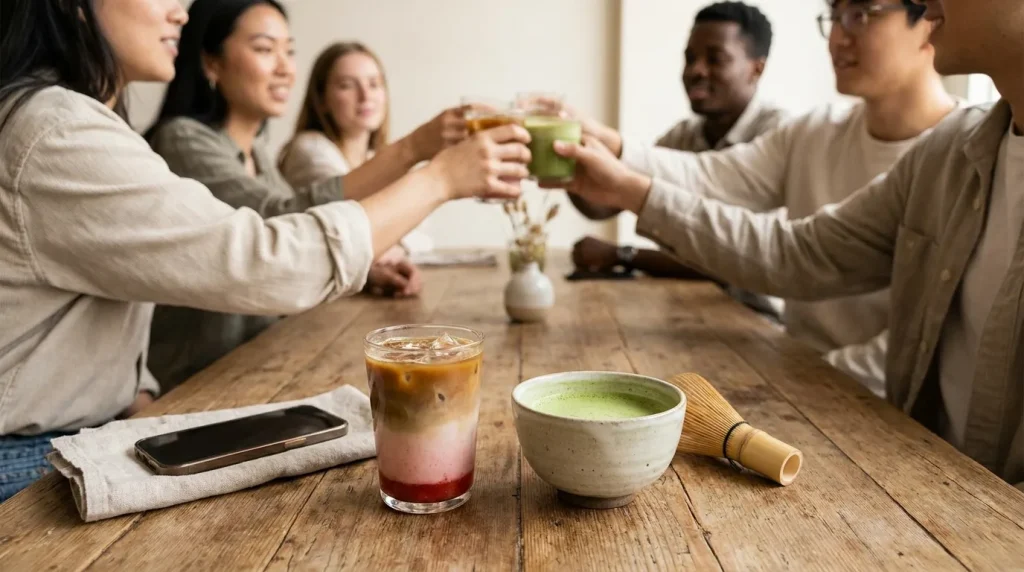
Matcha was made for a visual feed. Its green color reads instantly on a small screen, whisking creates motion, foam rewards close-up filming, and an iced latte fits neatly into café culture. Those qualities help explain why matcha recipes, tools, brands, and wellness claims keep returning across short videos, photo carousels, and café menus. They don’t prove that every recipe tastes good or that every health claim is sound.
Trend literacy gives you a better way to participate. Instead of treating a popular post as either trustworthy or worthless, split it into parts. Ask what format is spreading, what factual claim is being made, what evidence supports it, who benefits from your attention, and whether the post represents Japanese tea culture accurately. You can enjoy novelty while keeping standards.
What a matcha trend can and cannot tell you
A trend measures attention. It can show that many people are repeating a format, searching for an ingredient, or responding to a visual idea. It cannot establish safety, quality, historical accuracy, or a health effect. Recommendation systems reward material that earns viewing, reactions, saves, and remakes. Matcha offers creators several useful ingredients for that system: a dramatic color change, recognizable tools, a short preparation sequence, and room for personal variations.
Three questions often collapse into one: Is it popular? Is it accurate? Is it useful to me? Popularity answers only the first. Accuracy needs sources. Usefulness depends on your taste, budget, caffeine sensitivity, and purpose. A strawberry matcha can be a fun café drink even if its caption gives a shaky account of metabolism. Rejecting the claim doesn’t require rejecting the drink.
Cafés and the social formats that travel
Cafés turn matcha into formats customers can recognize and share. Layered iced drinks show contrast between milk and tea. Seasonal fruit purées add color. Sparkling versions create movement. Flights invite comparison, while limited menu drops create urgency. None of these formats needs to claim traditional status. They belong to modern café culture and can be judged as drinks: balance, texture, ingredient quality, price, and clarity about what is served.
Social posts often compress preparation into a repeatable sequence: sift powder, add water, whisk, pour over milk, reveal the layers. ASMR versions emphasize the scrape of a scoop, water hitting ceramic, and whisk movement. Tutorials favor overhead framing and exact steps. Reviews use a first sip and a rating. Behind-the-counter clips add labor and craft. Each format selects what viewers see and leaves other facts outside the frame, including recipe testing, waste, staff conditions, sponsorship terms, or how long a product sat open.
Read the format before reading the claim. A cinematic café video may be good evidence of atmosphere but weak evidence of flavor. A controlled comparison can reveal differences if the creator uses the same dose and method. A first-sip reaction captures a response, not a stable product verdict. Match the strength of your conclusion to the strength of the format.
Viral recipes: test the method, not the view count
Viral recipes usually succeed because they are easy to copy, visually distinctive, or attached to a familiar flavor. Common structures include matcha with strawberry, coconut water, vanilla cold foam, lemonade, tonic, or sweet cream. Others blend matcha into cookies, tiramisu, oats, and frozen desserts. These are culinary adaptations. Their value depends on whether the proportions work.
Before spending money, inspect recipe details. Does it state the matcha amount, water temperature, liquid volume, sweetener, and serving size? Does the creator show the full method rather than a jump cut from powder to perfect foam? Is the matcha whisked in enough water to disperse it? Does an acidic mixer create a flavor the creator acknowledges? Can you make a half portion first?
| Format | Useful signal | Possible hype | Best check |
|---|---|---|---|
| Layered latte | Shows texture and assembly | Color treated as proof of quality | Ask about origin, dose, and sweetness |
| Taste review | Describes one person’s experience | One sip framed as a final ranking | Look for method and disclosure |
| Wellness routine | Shows habit and serving context | Personal outcome framed as medical proof | Check qualified health sources |
| Recipe tutorial | Can provide reproducible steps | Missing quantities hidden by edits | Require a complete written recipe |
| Traditional preparation | May teach tools and technique | Casual styling labeled as ceremony | Compare with a recognized tea school |
Grade language also needs care. Terms such as ceremonial grade aren’t regulated as a universal legal ranking. A costly powder may taste subtle when whisked with water but disappear under fruit, milk, and syrup. For mixed drinks, choose a powder with enough flavor for the recipe and transparent origin information. Save delicate matcha for plain preparation if that is where you notice its value.
How to assess creator claims
Start by identifying the claim type. Taste claims are subjective. Preparation claims can often be tested. Historical claims need credible cultural or academic sources. Nutrition and health claims need stronger evidence, especially when they promise treatment, prevention, weight change, or a predictable mental effect. Green tea contains caffeine and catechins, but the National Center for Complementary and Integrative Health describes evidence for many proposed benefits as limited or mixed. That is far from proof that one branded drink will deliver a specific result.
Then inspect the creator’s relationship to the product. Payment, free products, affiliate commissions, employment, and discount codes create material connections. The US Federal Trade Commission says those connections should be disclosed clearly and conspicuously. A vague thanks, a buried hashtag, or a disclosure visible only after expanding a caption may not give viewers useful notice. Platform labels help, but viewers should still understand the relationship from the content.
Expertise should fit the subject. A skilled barista can explain workflow and texture. A tea producer can describe its own growing and processing practices, while still having a commercial interest. A registered dietitian or medical researcher may be better placed to discuss evidence, but credentials don’t make every statement correct. Strong creators show sources, define limits, separate experience from research, and correct errors openly.
Claim ladder
- Observation: “This drink tasted less bitter to me.” Useful as personal experience.
- Repeatable method: “Sifting reduced clumps in these preparations.” Testable with the same method.
- General claim: “This technique always makes matcha smoother.” Needs broader testing and clear conditions.
- Health claim: “This matcha fixes anxiety or causes weight loss.” Needs high-quality evidence and careful medical context.
The higher a claim climbs, the more evidence it needs. A personal story can inspire a recipe. It shouldn’t become a diagnosis or prescription.
Cultural context without freezing culture
Matcha has deep ties to Japanese tea practice, including chanoyu traditions taught by schools such as Urasenke. Formal tea practice involves learned procedures, utensils, hospitality, setting, and principles commonly expressed as harmony, respect, purity, and tranquility. A sweet iced café drink isn’t a tea ceremony. It doesn’t need to be one.
Respectful participation starts with accurate language. Call an adaptation an adaptation. Credit Japanese origins without claiming that one modern recipe represents all Japanese practice. Avoid using sacred, ceremonial, or Zen language as decoration when you can’t explain the connection. Learn correct tool names where relevant, pronounce them with care, and link to recognized cultural institutions when teaching history.
Culture also changes through contact, migration, business, and individual creativity. Respect doesn’t mean banning new flavors or insisting on one approved drink. It means giving context, avoiding false authority, and not erasing people whose knowledge made the ingredient legible to a global audience. Curiosity is stronger than costume.
Separate signal from hype
A useful signal remains informative after you remove dramatic music, captions, and sales pressure. It might be a complete recipe, a disclosed tasting method, a named tea origin, a link to a primary source, or a transparent correction. Hype depends on urgency and certainty: everyone is switching, experts don’t want you to know, one scoop changes everything, or a product is selling out forever.
Use lateral reading rather than staying inside one post. Open the cited source. Check whether it supports the exact claim. Search the institution or paper separately. Note study population, dose, comparison, and limits. For a product claim, look at the seller’s own details and at independent coverage. For cultural history, prefer museums, universities, recognized tea schools, and well-sourced scholarship over copied captions.
Absence of proof doesn’t always mean a claim is false. It means confidence should stay low. Say “may,” “in this recipe,” or “I noticed” when that is all the evidence allows. Precise uncertainty is more trustworthy than borrowed certainty.
Responsible sharing checklist
Before reposting, publishing, or recommending a matcha trend, take these actions:
- State whether the content is a recipe, review, personal routine, historical explanation, or health claim.
- Give quantities and method when others are expected to reproduce a result.
- Disclose payment, gifts, affiliate links, employment, and discount codes where viewers will notice.
- Link the original source, not a chain of accounts repeating the same statement.
- Distinguish personal experience from evidence that applies to other people.
- Avoid guaranteed health outcomes and refer medical questions to qualified professionals.
- Name modern café adaptations honestly instead of presenting them as formal tea ceremony.
- Credit origin, makers, and educators when their work shaped the post.
- Correct meaningful errors in the original format or with equal visibility.
- Consider waste, cost, caffeine, allergies, and accessibility before urging everyone to copy a trend.
This checklist doesn’t make a post dull. It makes the useful part easier to trust. Clear disclosure, exact recipes, and honest context give viewers more freedom to decide.
A practical FLOW for matcha trend literacy
Find the original post, recipe, claim, and source. Learn what type of evidence fits the claim and what cultural context is missing. Observe incentives, including sponsorship, affiliate sales, attention, and café promotion. Weigh the result, then share with language no stronger than the evidence. This FLOW turns scrolling into a short evaluation process without demanding suspicion toward every creator.
Good trend literacy leaves room for pleasure. Make the bright drink. Visit the café. Try the unusual pairing. Keep the caption honest, the source visible, and the conclusion proportionate. Matcha doesn’t need miracle claims to deserve attention.
Editorial standards and expertise
This guide distinguishes culinary opinion from factual claims and uses government health guidance, consumer protection rules, an international tea definition, Japanese tea industry standards, and a recognized tea school for cultural context. It doesn’t diagnose conditions, promise outcomes, rank unnamed creators, or infer motives without evidence. Sources below support the specific claims attributed to them. Product quality and platform rules can change, so check current labels, policies, and first-party information before acting.
Frequently asked questions
- Why does matcha trend so well on social media?
- Its vivid color, short preparation sequence, recognizable tools, and easy recipe variations create strong visual formats. Those features explain shareability, not factual accuracy.
- Are viral matcha health claims reliable?
- Some posts start with real facts about green tea compounds, then promise outcomes the evidence doesn’t establish. Check the exact claim against qualified health sources and avoid guaranteed results.
- Do viral latte recipes need expensive matcha?
- Usually not. Milk, fruit, and sweeteners can cover subtle flavors. Choose a transparent product that tastes balanced in the intended recipe, then reserve delicate powder for plain whisking if preferred.
- How can I spot a sponsored matcha recommendation?
- Look for plain disclosure of payment, gifts, affiliate links, employment, or discount codes near the recommendation. Don’t rely only on enthusiasm or production quality to infer sponsorship.
- Is a modern iced matcha disrespectful to Japanese tea culture?
- No. New drinks can be enjoyed as café adaptations. Problems arise when creators erase origins, misuse ceremonial language, or present a casual recipe as formal chanoyu without context.