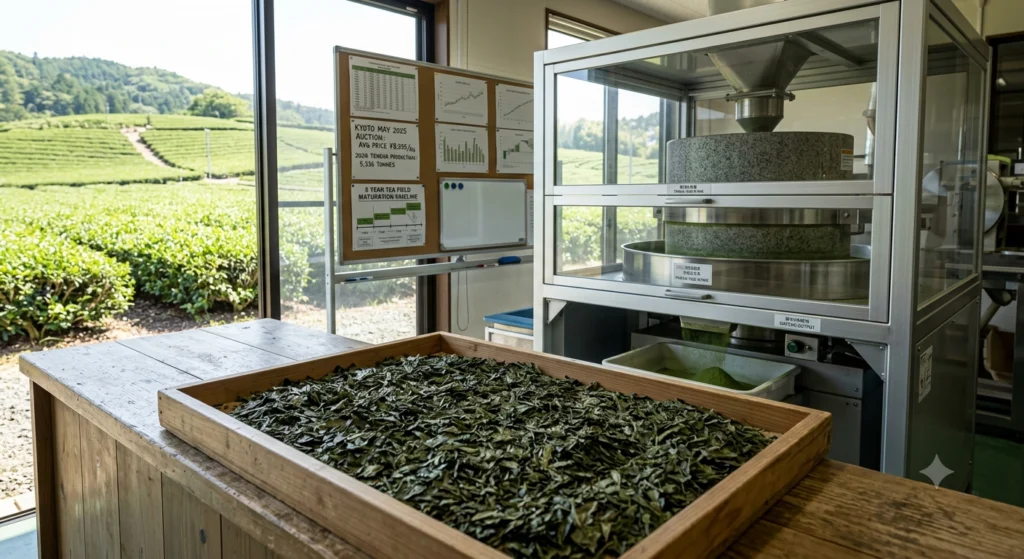
Matcha demand can change faster than tea agriculture. Fields take years to establish, weather can reduce harvests, and added processing capacity does not appear on demand. A useful view of the matcha industry therefore starts with tencha supply, not retail forecasts or loosely defined product grades.
This guide summarizes evidence available through 2025 from Reuters and Japan’s Ministry of Agriculture, Forestry and Fisheries, known as MAFF. Figures are dated and scoped because tencha production, green tea exports, auction prices and finished matcha sales measure different things.
What the matcha industry includes
The matcha industry connects tea agriculture, tencha processing, milling, blending, packing, certification, distribution and retail. Tencha is the processed leaf material milled to make matcha. That makes tencha production a useful supply indicator, although it is not identical to the volume of finished matcha sold in any specific year or market.
Industry language is less consistent further down the chain. Terms such as ceremonial, premium and culinary may describe intended use or a seller’s internal range, but they do not by themselves prove origin, production method, harvest date, freshness or sensory quality. Our guide to choosing matcha explains how buyers can assess those questions separately.
Japan’s 2024 tencha production and green tea exports
Reuters reported on July 4, 2025 that Japan produced 5,336 tonnes of tencha in 2024, nearly 2.7 times the volume produced ten years earlier. This shows substantial long-term expansion, but it does not establish how much finished matcha reached consumers, how production was divided among grades, or how much came from each region.
The same Reuters report said Japanese green tea exports rose by 25% in value to ¥36.4 billion and by 16% in volume during 2024, with the increase largely driven by powdered teas. Those export figures cover green tea more broadly. They are not exact matcha export totals, and they should not be relabeled as such.
| Measure | Reported result | Interpretation limit |
|---|---|---|
| Japanese tencha production, 2024 | 5,336 tonnes, nearly 2.7 times the level ten years earlier | Tencha supply indicator, not a finished-matcha sales total |
| Japanese green tea exports by value, 2024 | ¥36.4 billion, up 25% year over year | Includes green tea categories beyond matcha |
| Japanese green tea exports by volume, 2024 | Up 16% year over year | Growth was largely driven by powdered teas, but the figure is not matcha-only |
Heat, harvest pressure and tencha prices in 2025
Reuters described heat stress as one constraint on the 2025 supply response. One Kyoto grower told Reuters that a harvest normally around two tonnes fell to 1.5 tonnes because of heat. This is a documented example from one grower, not a national yield estimate.
At a Kyoto auction in May 2025, the average tencha price reached ¥8,235 per kilogram, 170% above the previous year’s level, according to Reuters. That result records a specific place, month and auction. It should not be treated as the standard price for all Japanese tencha or every supplier contract.
Together, the figures show why rapid demand growth can create price pressure even after years of production expansion. Weather can reduce output at the same time that buyers seek more material.
Why matcha capacity cannot expand instantly
Reuters reported that new tea fields need about five years before their first harvest. Agricultural expansion therefore involves a long delay before added land can contribute leaves. Producers must also align cultivation with tencha processing and milling rather than assume that any increase in general tea output becomes matcha supply.
MAFF’s 2025 Basic Plan calls for shifting production and processing toward organic tea and tencha in response to expected demand. Policy direction can support investment, but it does not remove biological lead times, climate exposure, workforce constraints or the need for suitable processing capacity.
Buyers should be cautious when a supplier claims that scarce origin-specific supply can scale immediately without a change in price, specification, producer base or delivery schedule.
Regions, growers and processors
Regional names can help identify where tea was grown or processed, but they do not replace lot-level evidence. The supplied national sources do not provide a complete 2024 breakdown of tencha volume by region, producer type or product grade. Reuters offers evidence from Kyoto, including its May 2025 auction and an individual grower’s heat-affected harvest, but those examples should not be generalized to every producing area.
The supply chain may involve growers, producer groups, processors, millers, blenders and exporters. Buyers should ask which parties handled a specific lot and which location each origin statement describes. A regional label may refer to cultivation, processing, blending or a seller’s sourcing area unless documentation makes the scope clear.
No claim about a protected origin should be inferred from a place name without evidence of the applicable rule and the product’s compliance with it.
Sourcing due diligence for buyers and brands
Good sourcing starts with questions that can be answered for a specific product or lot. Request the country and region of cultivation, production or harvest period, producer or processor identity, lot code, intended use, storage history, and any certification documents connected to the claim.
- Confirm whether a volume figure describes leaves, tencha, finished matcha or all powdered tea.
- Ask whether an origin statement covers cultivation, processing, milling and blending, or only one stage.
- Check dates on harvest, processing, packing, analysis and certification records.
- Request the criteria behind seller-defined grades rather than assuming a universal standard.
- Separate organic certification, residue information and sensory evaluation.
- Compare promised volumes and delivery times with the stated producer base and crop year.
Brands designing specifications can use the quality testing hub to separate documentary claims from measurable product attributes. Readers seeking more production context can continue with the deeper dive into matcha.
Quality, authenticity and the limits of labels
No single label proves every aspect of matcha quality. Country or region of origin does not establish freshness, particle condition, flavor, storage quality or suitability for a particular preparation. Color and taste can also be affected by cultivar, cultivation, harvest timing, processing, milling, storage and preparation, so a photograph or marketing description cannot settle authenticity on its own.
Due diligence should match the claim. Traceability documents can support origin. Certification can support compliance with a defined production system. Testing can answer selected analytical questions. Sensory assessment can describe the prepared product. None should be presented as proof of all the others.
What Organic JAS certification covers
MAFF’s Organic JAS guidance describes a certification system for organic production and processing practices. It includes standards, records, inspection and controls on how qualifying products are produced and labeled.
Organic JAS does not guarantee zero residues, a specific sensory profile, greater freshness or superior matcha quality. A certified product can meet an organic production standard while still differing from another certified product in origin, harvest, processing, storage and taste. Buyers should verify that a certification applies to the product and operator in question, then evaluate other claims separately.
Climate, labor and mechanization
The 2025 Reuters report provides a concrete warning about heat exposure through the Kyoto grower’s reduced harvest. MAFF’s Basic Plan addresses climate adaptation more broadly across Japanese agriculture and supports smart agriculture and mechanization.
The plan reports an average agricultural workforce age of 69.2 years. This is a general agriculture figure, not a tea-specific workforce statistic. It signals a national labor challenge but cannot establish the age, staffing level or succession position of a particular tea region or producer.
Mechanization may help with selected field and processing tasks, while climate adaptation may change cultivation and risk management. Neither removes the need for skilled decisions, suitable land, crop development time and quality control.
Sustainability under supply pressure
Sustainability claims should identify the practice, location, period and evidence involved. Broad claims such as climate-friendly, ethical or regenerative are difficult to assess without defined criteria and records.
Useful questions include how farms manage soil and inputs, how processors use energy and water, how workers and producer relationships are handled, and how packaging and transport choices are documented. Organic JAS can answer part of the production-practice question when certification is valid, but it is not a complete environmental or social impact assessment.
Supply pressure also creates trade-offs. Rapid expansion can compete with long crop lead times, limited labor and climate adaptation needs. Buyers can reduce avoidable pressure by setting realistic forecasts, accepting transparent crop variation, avoiding waste and paying attention to supplier continuity rather than purchasing only on short-term price. See our sustainability and ethics hub for the wider evaluation framework.
Matcha production beyond Japan
Powdered green teas are produced outside Japan, but the supplied Reuters and MAFF sources do not provide a reliable global matcha production total or a single standard that makes every product directly comparable. Avoid precise global shares unless a source defines matcha, geography, period and measurement method.
For any origin, buyers should compare cultivation, raw material, processing, milling, storage, traceability and intended use. The internal guide Beyond Japan: Global Matcha Production and Quality Differences offers further background. It should not replace primary evidence for a specific producer, region or market claim.
Practical implications for buyers and brands
- Plan earlier: agricultural supply cannot react on retail timelines, and Reuters reported a roughly five-year wait before new tea fields produce a first harvest.
- Define the product: specify whether a request concerns tencha, finished matcha or a wider powdered tea category.
- Date every comparison: the May 2025 Kyoto auction result reflects an unusually pressured period, not a permanent universal benchmark.
- Allow crop variation: weather can change available volume and product characteristics between years.
- Verify claim scope: origin, organic status, testing and sensory quality require different evidence.
- Avoid forecast-led certainty: market projections cannot make fields mature faster or prove future supply.
- Build alternatives deliberately: assess more than one qualified source without treating unlike origins or specifications as interchangeable.
How Best Matcha evaluates industry claims
Best Matcha starts with source scope. We check who published a figure, its date, geography, product category and measurement. Tencha is not automatically finished matcha. Powdered tea is not always matcha. Green tea export data cannot be reported as matcha-only data unless the source provides that split.
We also separate national evidence from individual examples. Reuters’ Kyoto grower illustrates heat-related loss, but one farm’s result is not a Japanese average. The Kyoto auction documents price pressure at a defined event, not every transaction. MAFF’s workforce age describes agriculture generally, not tea workers alone.
For product claims, we match evidence to the question. Certification supports compliance within its stated scope. Traceability can support origin. Analysis can answer defined test questions. Sensory descriptions require clear methods and context. Claims without enough evidence remain qualified or are excluded.
References
- Michele Pek and Yuka Obayashi, “Japan’s heat-stressed matcha tea output struggles to meet soaring global demand”, Reuters, July 4, 2025.
- Ministry of Agriculture, Forestry and Fisheries of Japan, Basic Plan for Food, Agriculture and Rural Areas 2025, reference material, 2025.
- Ministry of Agriculture, Forestry and Fisheries of Japan, Organic JAS Q&A.
Articles