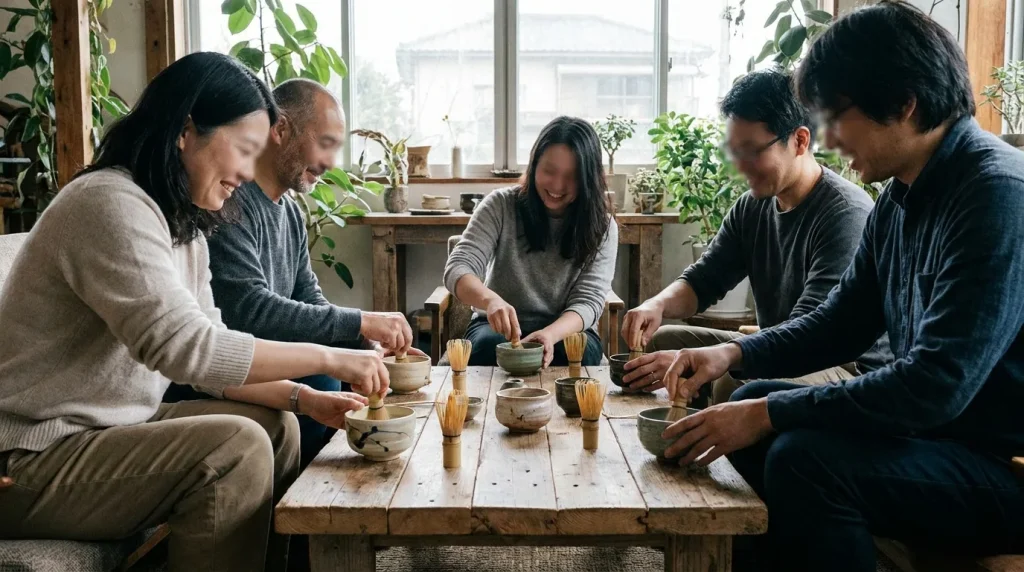
A good matcha community helps people practice, ask better questions, and form real connections without turning Japanese tea culture into a costume or a claim of borrowed authority. Community can take many forms: two friends comparing whisking methods, a local tea club, a public demonstration led by a trained practitioner, an online study group, or volunteers documenting accessible venues. What matters is not group size. It is whether participants are honest about their experience, respectful about sources, and willing to make room for others.
This guide offers a practical path for finding and joining matcha communities. It covers practice groups, cultural respect, local events, online spaces, inclusive participation, story verification, and responsible contribution. It does not present invented testimonials or anonymous success stories. Instead, it gives methods you can use to assess any group or account for yourself.
Find a practice group that fits your purpose
Start by deciding what you want from a group. A casual tasting circle serves a different purpose from formal study of chanoyu, the Japanese way of tea. A recipe club may focus on drinks and food, while a cultural organization may host lectures, exhibitions, or demonstrations. None of these formats is automatically better. Problems begin when a casual group presents itself as a formal authority or when an event uses cultural language only as decoration.
Write down one clear aim: improve whisking, taste regional differences, study tea history, meet local drinkers, or learn from a qualified teacher. Search community calendars, public libraries, museums, universities, Japanese cultural organizations, specialist tea shops, and established tea associations. Ask who leads the activity, what training or experience they claim, what the fee covers, and whether beginners may observe before joining.
For formal instruction, look for a named school, teacher lineage, or institutional affiliation that can be checked through an official organization. For casual practice, expect modest claims and clear boundaries. A trustworthy host can say, “This is an informal tasting group,” without implying certification.
| Format | Good for | Check before joining |
|---|---|---|
| Informal practice circle | Whisking, tasting, shared learning | Cost sharing, allergy notes, beginner access, host claims |
| Tea school or study group | Structured practice and cultural study | School affiliation, teacher credentials, schedule, etiquette |
| Museum or cultural event | Public education and demonstrations | Named presenters, program sources, accessibility details |
| Tea shop event | Product comparison and preparation | Commercial purpose, brands served, refund policy |
| Online community | Questions, remote study, event discovery | Moderation, sourcing rules, privacy, advertising labels |
Approach ceremony and culture with respect
Matcha is closely associated with Japanese tea traditions, but drinking matcha does not make every gathering a tea ceremony. The term chanoyu refers to traditions shaped through sustained study, schools, utensils, architecture, seasonality, calligraphy, flowers, food, and relationships between host and guest. A home whisking routine can be sincere and valuable without being labeled a ceremony.
Use specific language. Say “informal matcha practice” when that is what you mean. Name a school or tradition only when the connection is real and relevant. Credit teachers, translators, authors, institutions, craftspeople, and photographers. Japanese terms should clarify a concept, not decorate marketing copy. If you do not know the correct term or context, plain English is better than confident guesswork.
Cultural respect also includes ordinary conduct. Follow the host’s guidance. Ask before touching utensils or taking photographs. Do not record participants without consent. Avoid treating clothing, gestures, or sacred and historic objects as props. If a teacher corrects a movement or word, accept the correction without demanding that they represent all Japanese people or every tea school.
Evaluate local clubs and events
A polished event page does not prove expertise, and a small noticeboard group is not necessarily unreliable. Check evidence that matches the claim. If an organizer promises formal instruction, verify the instructor. If the event is a product tasting, look for ingredient, caffeine, allergen, and sales information. When a venue calls itself accessible, confirm the entrance, seating, toilets, lighting, sound, and transit details rather than relying on a single accessibility icon.
Contact organizers with short, concrete questions. Ask whether participants sit on chairs or the floor, whether fragrance-free attendance is encouraged, whether interpretation is available, and whether tasting is optional. People who cannot consume caffeine should still be able to attend educational portions when the format allows. A group can offer water, scent-free dry-leaf viewing, printed notes, or a non-tasting observer place without pretending these are equivalent to drinking matcha.
Costs should be clear before registration. Tea, sweets, venue hire, instructor time, and equipment all have value, but surprise sales pressure damages trust. Ethical hosts disclose sponsorships, affiliate relationships, and products available for purchase. They also explain cancellation terms and what happens if an event cannot run.
Choose online groups with healthy norms
Online matcha groups can connect people who have no local club, limited mobility, or uncommon interests. They can also spread copied claims quickly. Before investing time, read group rules and several weeks of discussion. Healthy spaces distinguish personal taste from fact, require commercial disclosure, discourage medical advice, and allow corrections with sources.
Look at moderation in practice. Are insults removed consistently? Can members ask basic questions without ridicule? Do sellers dominate recommendations? Are deleted posts explained when safety or misinformation is involved? A long member count says little about discussion quality. Smaller groups with active moderation and searchable resources often serve learners better.
Protect your privacy. Do not post home addresses, private event access codes, order numbers, or health details. Remove location metadata from photos when needed. Get consent before reposting another member’s image or comment outside the group. Screenshots can travel far beyond their original setting, even when a group is described as private.
Make participation inclusive
Inclusion is not a promise that every activity can suit every person. It is a habit of giving useful information, offering reasonable choices, and avoiding needless barriers. Publish venue and format details early. Use readable registration forms. Provide a contact method that does not require public disclosure of disability, religion, age, or health.
Hosts can offer chairs, quiet seating, large-print notes, captions for online sessions, breaks, and clear start and end times. Explain whether kneeling, bowing, eating sweets, or drinking tea is expected, optional, or part of a specific instructional form. Never pressure someone to consume caffeine, disclose a diagnosis, or defend a dietary choice.
Participants share responsibility. Avoid jokes about pronunciation or beginner tools. Do not rank people by the price of their matcha or utensils. Leave room for quieter members to speak. Use people’s stated names and pronouns. When discussing Japan, resist broad claims about what “the Japanese” think or do. Specific sources, periods, regions, schools, and speakers produce more accurate conversation.
Verify stories before sharing them
Community stories can preserve knowledge and encourage participation, but vivid detail does not guarantee truth. First-person accounts should remain clearly attributed to the speaker. Historical claims need independent sources. Product experiences need context such as preparation, date, storage, and whether the item was gifted. Health claims require high-quality medical evidence, not repetition across social posts.
Use a simple verification sequence. Identify the original speaker or publication. Check the date and whether words were edited. Separate observation from interpretation. Find a primary source or a credible institution for factual claims. Ask permission for names, images, and quotations. Record corrections openly. If a claim cannot be confirmed, label it as unverified or leave it out.
Translation needs added care. Keep the original text, translator name, publication details, and context. Machine translation can help locate material, but it should not be presented as authoritative translation of specialized cultural language. When meanings differ among schools or authors, report that difference rather than forcing one universal definition.
A useful community story tells readers who spoke, what they directly experienced, what can be checked, and what remains interpretation.
This standard protects both readers and contributors. It also prevents a common form of extraction: taking a personal account, removing its source, and republishing it as generic brand content.
Contribute something the community can use
You do not need expert status to help. Reliable event notes, venue accessibility details, corrected captions, a consented photo archive, or a clear beginner question can all improve a group. State your role and limits. “Participant notes from a public lecture” is more useful than implying that your summary is an official transcript.
For interviews or profiles, agree on scope before recording. Tell contributors where material will appear, whether it may be edited, how they can request corrections, and whether publication is commercial. Let people review direct quotations when possible. Do not promise anonymity if names, images, locations, or unusual details make identification likely.
When correcting misinformation, address the claim rather than attacking the person. Quote the exact point, link to evidence, and explain what changes. If you made the mistake, update the original post where readers will see it. Quietly correcting a later copy while leaving a popular false version live does not repair the record.
A four-week community action plan
- Week one, define purpose. Choose one aim and list access needs, budget, preferred group size, and travel or time limits.
- Week two, check options. Review three local or online groups. Check leadership claims, moderation, costs, source habits, privacy, and accessibility.
- Week three, participate lightly. Attend one public event or observe one online discussion. Follow rules, ask one focused question, and take notes without photographing others.
- Week four, contribute carefully. Share one sourced resource, accessibility update, event correction, or concise practice note. Credit people and ask consent where needed.
After four weeks, assess the fit. Did you learn something specific? Were newcomers treated well? Could members disagree without hostility? Were cultural and commercial claims clear? Stay if the group supports honest learning. Step away if it pressures purchases, tolerates harassment, invents credentials, or repeatedly publishes unsupported claims.
How this guide handles expertise and trust
This page gives participation and verification methods, not instruction in a specific school of Japanese tea. Its cultural guidance is grounded in public educational material from established Japanese cultural and tea institutions. Its inclusion guidance follows practical access principles, while health and caffeine questions should be taken to qualified clinicians and public health sources.
Source quality depends on the claim. Official school or association pages are best for their own programs and terminology. Museums and universities can support historical context. Public agencies can support safety guidance. Named practitioners can describe their own training and experience, but no individual account proves a universal rule. Readers should check publication dates and current event details at the source.
Frequently asked questions
Do I need experience to join a matcha group?
No. Look for a group that explicitly welcomes beginners and explains its format, costs, etiquette, and equipment needs before you attend.
Is every matcha gathering a Japanese tea ceremony?
No. Casual tasting and whisking sessions can be meaningful, but formal tea traditions involve specific schools, teachers, study, and context.
How can I verify a teacher or event?
Ask for a named school, organization, or professional background, then check that claim through the institution’s official channel.
Can I participate without drinking matcha?
Often, yes. Ask whether observation, water, printed materials, or non-tasting parts are available. Hosts should not pressure anyone to consume caffeine.
What is the safest way to share a community story?
Get informed consent, preserve attribution and context, verify factual claims, disclose commercial ties, and provide a visible correction process.
Sources and further reading
- Urasenke Konnichian official English website, for information about Urasenke history, activities, and tea culture.
- Omotesenke Fushin’an official English website, for information about the Omotesenke tradition and organization.
- Japan Foundation arts and cultural exchange, for public cultural programs and institutional context.
- Ministry of Agriculture, Forestry and Fisheries of Japan, Japanese Tea, for an official overview of Japanese tea.
- W3C Web Accessibility Initiative, Introduction to Web Accessibility, for accessible communication and online participation principles.
Articles