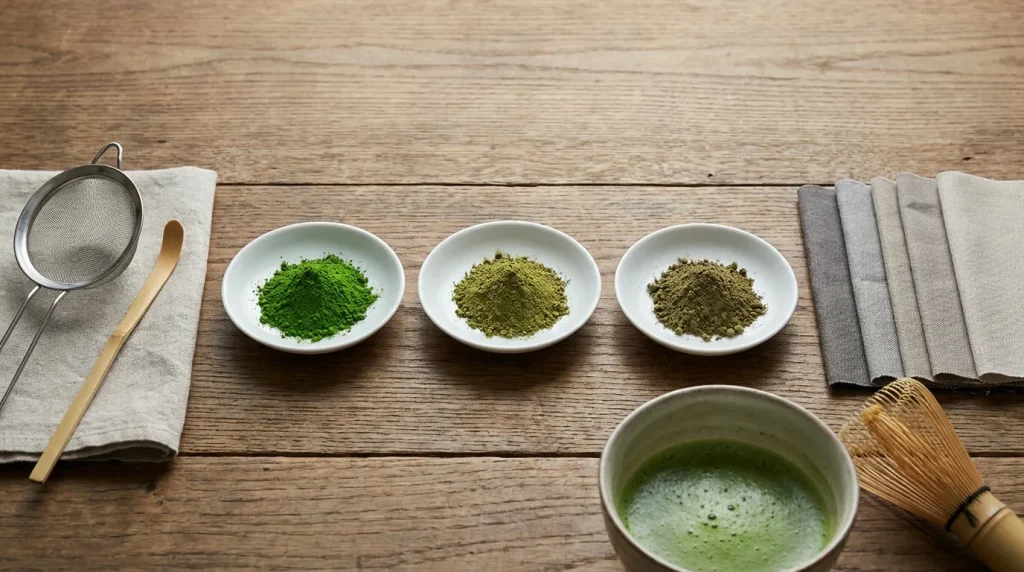
Matcha quality testing works best as a chain of evidence, not a single visual verdict. Color, aroma, texture, and taste reveal how a powder performs in the cup. Packaging, lot details, origin, and dates help explain freshness and traceability. Laboratory reports address questions that sight and taste cannot answer, including specific contaminants. Each layer has a different job.
This guide uses the FLOW approach: find observable evidence, link each sign to a plausible cause, optimize a repeatable home protocol, then weigh the result before buying again. It is designed for consumers comparing products, not for certifying a tea or replacing accredited analysis. Keep notes, control preparation variables, and treat strong claims with the same care you apply to the bowl.
Find: build a sensory baseline
Sensory evaluation asks what you can observe under consistent conditions. Professional tea assessment depends on trained comparison, controlled preparation, and shared vocabulary. At home, the goal is narrower: detect clear differences between tins, notice deterioration, and decide whether a product suits its stated use. You do not need to assign a universal score.
Start with neutral surroundings. Strong perfume, cooking odors, colored lighting, and recently eaten spicy food can distort perception. Use the same white bowl, sieve, scale, water, temperature, powder dose, and whisking time for every sample. Let water cool to a measured temperature rather than guessing. Taste samples close together, with plain water between them.
Record observations before reading detailed marketing copy. This reduces expectation bias. Note the dry powder first, then the wet aroma, first sip, finish, and texture after thirty seconds. A useful note names a sensation and its intensity, such as mild marine aroma, medium sweetness, firm bitterness, or drying finish. Words like premium and clean are conclusions, not observations.
Read color, aroma, and texture together
Color
Evaluate powder in diffuse daylight against a white surface. Fresh matcha commonly appears green, but hue varies with cultivar, shading, harvest, processing, particle size, storage, lighting, and camera settings. Dull olive, yellow, or brown tones may suggest age, heat, light exposure, oxidation, lower leaf quality, or a combination of factors. Color alone cannot identify origin, grade, contamination, or authenticity.
Compare only under identical light. Phone photos often increase saturation, and screens render green differently. A vivid image on a product page is not test evidence. If tracking one tin over time, photograph a small sample beside the same neutral reference card in the same location.
Aroma
Smell the powder immediately after opening. Then add water and smell again. Desirable character may include fresh vegetation, sweet grass, steamed greens, seaweed, nuts, flowers, or savory broth. Exact notes differ among teas and tasters. Flatness can indicate age or weak aromatic intensity. Cardboard, basement, rancid fat, smoke, perfume, or an unfamiliar chemical odor deserves caution, especially when paired with damaged packaging.
Aroma cannot prove microbial safety or absence of chemical residues. If a product smells plainly abnormal, stop tasting it and contact the seller with the lot number and photos. Do not try to diagnose a contaminant by odor.
Texture
Dry matcha should be finely milled, though touch is a rough test and repeated handling exposes powder to moisture. Small soft clumps often form because fine particles attract humidity and static charge. They usually break through a dry sieve. Hard lumps, visible moisture, webbing, foreign material, or damaged seals are different warning signs.
In water, well-sieved matcha should feel suspended and relatively smooth for its style. Grit can reflect coarser particles, poor dispersion, excessive powder, or settling. Foam height is not a direct grade test. Bowl shape, whisk condition, water amount, technique, and added ingredients all affect foam.
Link flavor to preparation and intended use
Taste integrates sweetness, umami, bitterness, astringency, aroma, body, and finish. Good quality does not mean zero bitterness. A balanced straight-drinking matcha may combine savory depth, gentle sweetness, lively bitterness, and limited drying sensation. Culinary products can be more assertive so their flavor remains present with milk, sugar, or fat.
When a bowl tastes harsh, test preparation before blaming the powder. Lower water temperature, verify dose, use less water only if concentration is intended, and avoid whisking with boiling water. Change one variable at a time. If harshness persists across a controlled retest, it is reasonable to judge that tea unsuitable for your preferred preparation, even if another buyer likes it.
Quality is partly fitness for purpose. A subtle tea can disappear in a sweet latte, while a powerful culinary matcha may taste severe as usucha. Compare products within the same use case and approximate price range. Sensory preference should be reported as preference, not as chemical proof.
Check labeling, freshness, and traceability
A useful label identifies the food, responsible business, net quantity, required date information, storage directions where needed, and origin information required by the market in which it is sold. Rules vary by jurisdiction. For imported matcha, look for a clear Japanese origin statement, seller or importer contact details, and a lot or batch code. A regional name, cultivar, harvest season, or producer can add traceability, but absence does not automatically make a lawful product unsafe.
Terms such as ceremonial grade are not a universal government quality standard. Organic certification addresses compliance with a defined production and handling system. It does not guarantee preferred flavor, maximum freshness, or zero detectable residue. Awards, stone-milled claims, cultivar names, and first-harvest statements may help describe a product, but they need context and trustworthy documentation.
Freshness depends on time plus exposure to oxygen, heat, light, and moisture. Favor opaque, well-sealed packaging sized for realistic use. Before opening, inspect seams, dents, punctures, swelling, and tamper features. After opening, close the container promptly with dry hands and tools. Follow maker storage instructions. If refrigerating, keep the tin tightly sealed and let it reach room temperature before opening so condensation does not form on cold powder.
A best-before date usually concerns quality under stated storage conditions, not a promise that flavor remains unchanged after opening. Write the opening date on the tin. Track aroma and color over several weeks. This personal timeline is more useful than assuming every product declines at the same rate.
Know contaminant and laboratory-testing boundaries
Home sensory checks cannot determine concentrations of lead, cadmium, arsenic, pesticide residues, microbial hazards, mycotoxins, or radionuclides. Matcha is consumed as whole powdered leaf, so questions about sourcing and testing are reasonable. Answers require defined methods, suitable sampling, competent laboratories, and results interpreted against applicable legal limits.
A credible test report should connect to the exact product or lot. Look for sample identity, collection or receipt date, laboratory name, method, analyte list, units, results, reporting or quantification limits, and authorized signoff. ISO/IEC 17025 accreditation can show that a laboratory is assessed for technical competence within a stated scope. Accreditation is not a blanket guarantee for every test, so confirm that relevant methods or analytes fall within scope.
Statements such as lab tested, passes heavy metals, or clean are incomplete without scope. Which metals? Which pesticide panel? What method and detection limit? What batch? Which standard defined pass? A non-detect result means the analyte was not detected above the method’s stated limit. It does not prove absolute absence.
Certificates of analysis can support due diligence, but one report may not represent every future lot. Testing also does not repair weak traceability or poor storage. When evidence is missing, ask the seller precise questions. Avoid publishing accusations based on taste, color, or an unverified screenshot. Report suspected food safety problems to the seller and appropriate local authority.
Optimize: run a repeatable home protocol
- Log identity. Record brand, product name, origin statement, lot code, package size, purchase source, best-before date, opening date, and price per gram.
- Inspect packaging. Photograph the unopened container. Note seal condition, damage, storage instructions, importer details, and claims you want to verify.
- Standardize conditions. Use a white bowl, neutral light, digital scale, thermometer, same water, clean sieve, and clean whisk. Avoid scented products nearby.
- Assess dry powder. Note hue, brightness, aroma intensity, soft or hard clumping, and visible foreign matter. Do not taste a sample with a broken seal, moisture damage, pests, mold-like growth, or abnormal odor.
- Prepare consistently. One practical comparison recipe is 2 grams of matcha with 60 milliliters of water at 75°C. This is a test condition, not a universal ideal. Sieve, add water, whisk for the same measured time, and serve immediately.
- Score observations. Use a five-point intensity scale for sweetness, umami, bitterness, astringency, aroma, smoothness, and finish. Add plain-language notes and an overall preference score.
- Retest once. Repeat on another day or prepare samples blind with help from another person. A single bowl can be affected by technique, food, mood, or expectation.
- Decide by purpose. Mark suitable for straight tea, latte, cooking, or not for repurchase. Keep safety conclusions separate unless supported by lot-specific laboratory or regulator evidence.
Compare evidence by what it can prove
| Evidence | Useful for | Cannot prove | Best practice |
|---|---|---|---|
| Color | Freshness tracking and side-by-side comparison | Safety, origin, grade, or authenticity alone | Use diffuse daylight and a white reference |
| Aroma and taste | Flavor quality, defects, balance, and preferred use | Contaminant concentrations | Control recipe and taste blind when possible |
| Texture and foam | Milling feel, dispersion, and preparation performance | Universal quality rank | Sieve and keep tools and technique constant |
| Label and lot code | Identity, legal information, and traceability | Flavor excellence or complete testing | Save package photos and purchase records |
| Certificate of analysis | Reported results for listed analytes and sample | Untested hazards or all future lots | Check lot, units, methods, limits, and laboratory scope |
Win: make a defensible buying decision
Combine evidence rather than chasing a perfect signal. A strong purchase has intact packaging, useful traceability, sensible storage guidance, a flavor profile suited to its use, and responsive answers to specific testing questions. Price can reflect scarce cultivars, skilled production, small lots, packaging, freight, and brand positioning. It is not proof by itself.
For reviews, disclose purchase source, lot, opening date, recipe, water temperature, and whether tasting was blind. Separate measured facts from sensory judgments and seller claims. This makes your evaluation reproducible and fair. People vary in taste sensitivity, and producers release new lots, so avoid turning one sample into a permanent verdict on an entire brand.
Repeatable notes produce the most practical result: you learn which origins, styles, prices, and freshness windows work for you. Laboratory evidence then answers narrower safety questions within its documented scope. Used together, these tools support better choices without pretending that a kitchen test can do the work of a laboratory.
Editorial method and limits
This guide distinguishes sensory evaluation, label review, and laboratory analysis because they answer different questions. Guidance draws on official food-labeling resources, international laboratory competence standards, and published tea research. It does not diagnose illness, certify products, or set legal limits. Regulations and recall procedures depend on location. Consumers with a suspected adverse reaction should stop using the product and seek advice from a qualified health professional or local poison service as appropriate.
Articles