Written by: Emilie Schol, founder of best-matcha.test
All health claims below are sourced to peer-reviewed research or established medical institutions. Where evidence is thin or borrowed from green-tea studies, I say so plainly.
The most credible matcha health benefits are its antioxidant activity (driven by EGCG, the dominant green-tea catechin) and L-theanine’s ability to smooth caffeine’s edge into sustained focus. Heart and brain benefits look promising but rest mainly on green-tea data, not matcha-specific trials.
That distinction matters. Matcha is whole-leaf green tea: you whisk the powdered leaf into water and drink the leaf itself, not a steeped extraction. That is why a 2g serving concentrates more catechins than a teabag yields. It also explains the “superfood” hype, and a lot of those claims outrun the evidence. This article separates what holds up from what is mostly marketing. If you want a grade actually worth drinking before you start, read the guide to the best matcha first.
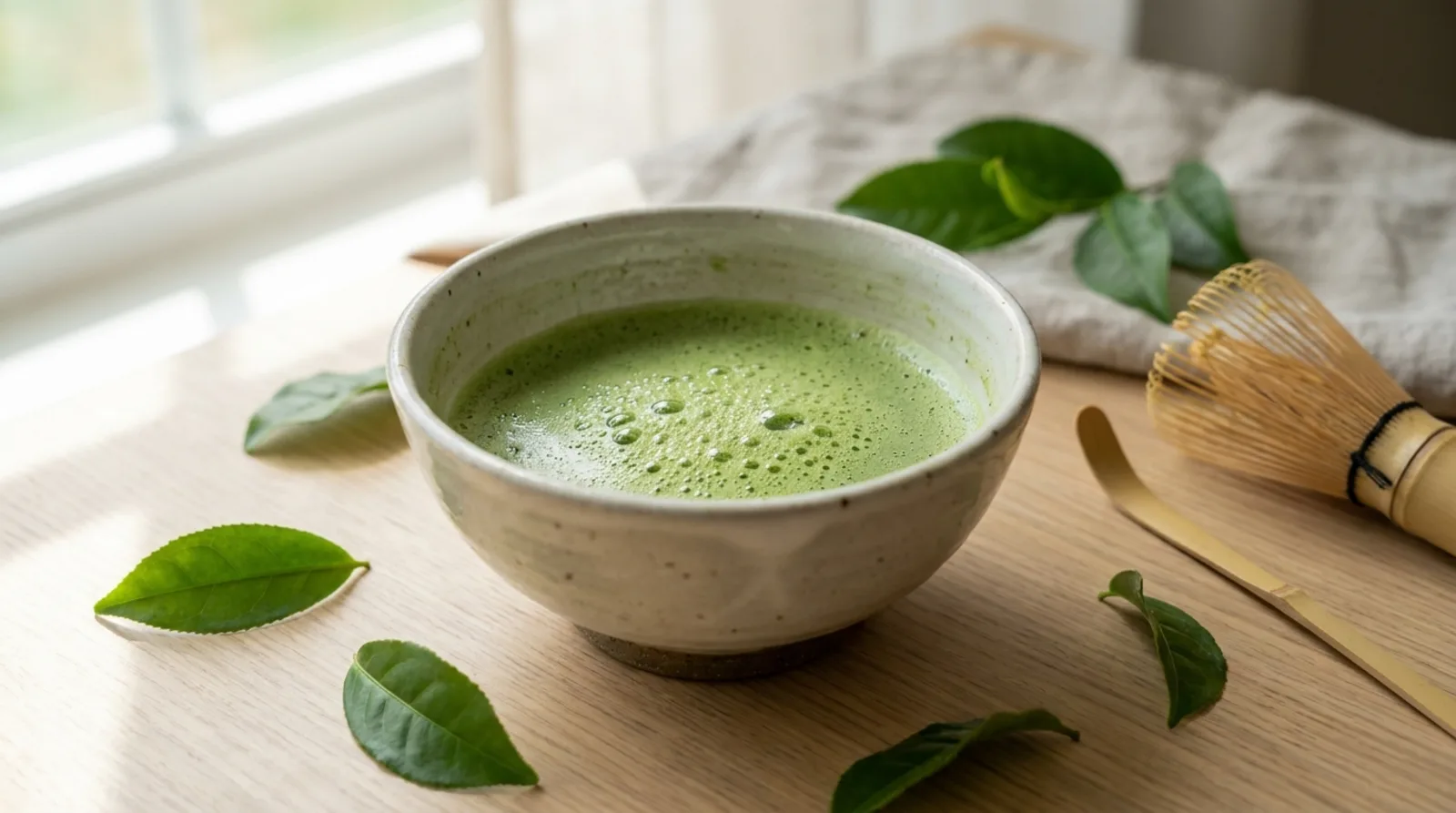
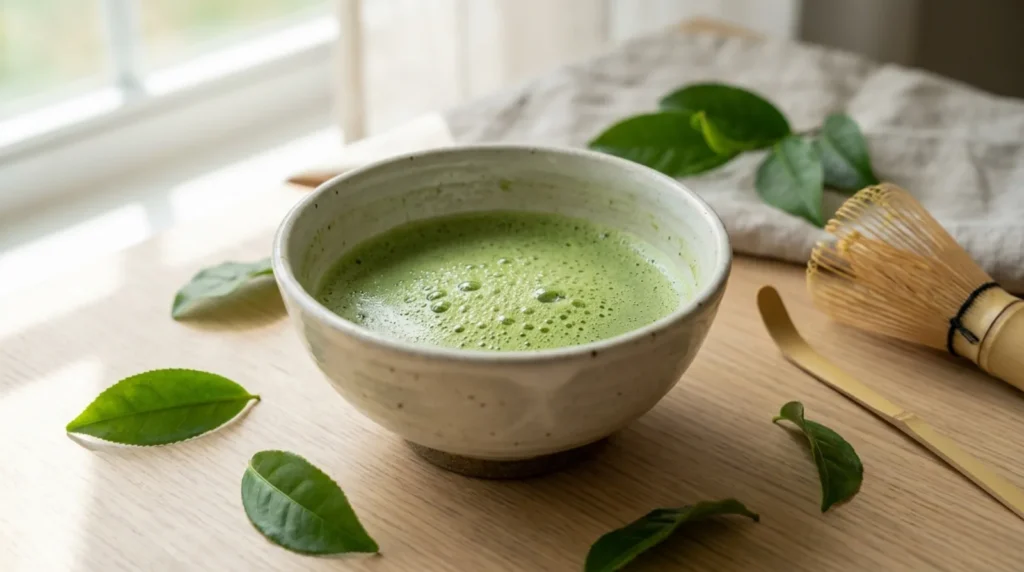
A bowl of stone-ground matcha set among fresh Camellia sinensis leaves.
This article is for general information only and is not medical advice. Matcha contains caffeine — if you are pregnant, caffeine-sensitive, or taking medication, check with your doctor before changing your intake.
Want to compare every option yourself? Browse our matcha marketplace — 119+ Japanese brands you can filter by grade, origin, and certification.
What are the main matcha health benefits?
Matcha’s compounds of interest are catechins (especially EGCG), other polyphenols, chlorophyll, and L-theanine. The strongest research supports antioxidant activity and L-theanine’s focus effect. Cardiovascular and cognitive signals exist, but most of the data extrapolates from green-tea trials rather than controlled matcha studies.
Quick map of this page:
| Topic | Strength of evidence |
|---|---|
| Antioxidants (EGCG) | Solid mechanism; mostly lab and green-tea data |
| L-theanine + calm focus | Controlled human trials; dose caveat applies |
| Heart health | Observational associations; no matcha RCTs |
| Attention & memory | 1 small matcha RCT (2021); needs replication |
| Weight management | Weak and mixed |
Matcha antioxidants: catechins, EGCG, and polyphenols
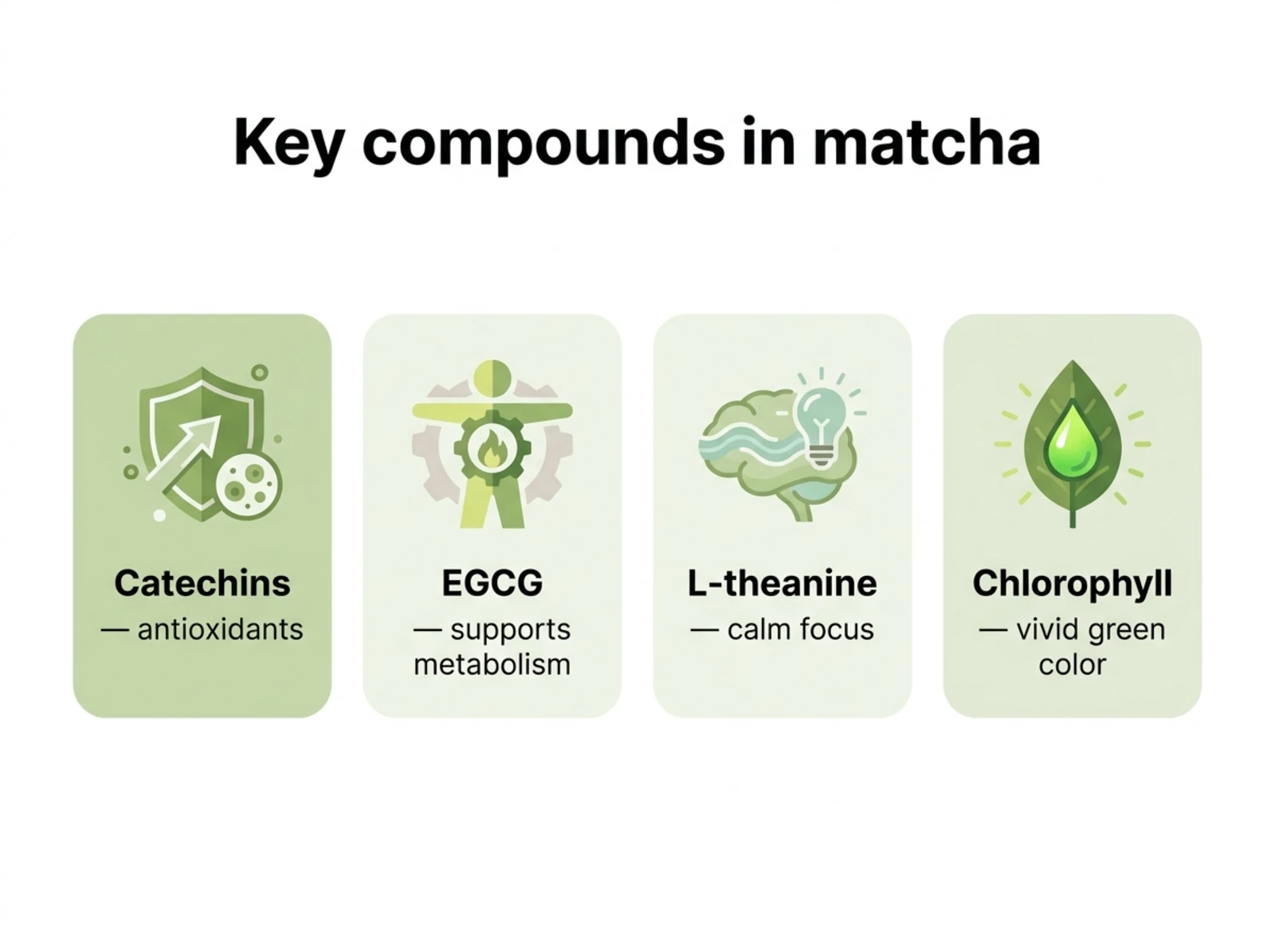
The four compounds most associated with matcha: catechins, EGCG, L-theanine, and chlorophyll.
Catechins are polyphenol antioxidants. Green tea carries 4 major ones: EGCG, EGC, ECG, and EC. EGCG (epigallocatechin gallate) is the most abundant and most studied. Because you consume the entire ground leaf in suspension rather than discarding it after steeping, a bowl of matcha can yield substantially more catechins than the same volume of brewed green tea. Shade-growing amplifies this: covering the Camellia sinensis plants for 3 to 4 weeks before harvest forces the leaf to synthesize more chlorophyll and L-theanine, and catechin concentrations follow.
What Does EGCG Do in the Body?
EGCG scavenges free radicals, the reactive oxygen molecules that accumulate and damage cells over time. A peer-reviewed review of EGCG’s antioxidant mechanism details how it neutralizes reactive oxygen species in lab assays. The caveat matters: most headline antioxidant figures come from in-vitro or animal work, or from general green-tea trials. The jump from “scavenges free radicals in a test dish” to “prevents disease in humans” is far larger than wellness blogs admit. Mechanism: real. Proven disease prevention in matcha drinkers: not yet demonstrated.
Compared side-by-side under identical preparation (70°C water, a 60-second whisk), ceremonial-grade and culinary-grade matcha differ in color, and that difference alone signals a genuine catechin gap. Ceremonial grades from Uji (Kyoto Prefecture) and Nishio (Aichi Prefecture) go vivid jade; lower-grade powder yellows. That color reflects chlorophyll concentration, which tracks catechin density. It is a rough proxy, but a useful one when you are buying blind.
Polyphenols and chlorophyll
Harvard Health confirms polyphenols as a well-documented antioxidant class. Chlorophyll gives matcha its color and is a real marker of leaf quality, but claims that it “detoxes” the body are not supported by clinical evidence. Your liver and kidneys handle detoxification; a green drink does not take over that work.
How matcha and steeped green tea compare on the points covered above:
| Factor | Matcha | Steeped green tea |
|---|---|---|
| What you consume | The whole 2g leaf in suspension | Water steeped from the leaf, leaf discarded |
| Catechins per serving | Higher | Lower |
| Shade-grown before harvest | Yes, 3–4 weeks | Usually no |
| L-theanine per bowl | About 20–40mg | Lower per serving |
| Typical prep | 2g powder, 80ml water, 70°C | Loose leaf, hot water, steep and strain |
Practical note: shade-growing raises catechin levels and caffeine together. For exactly how much caffeine a bowl delivers, the matcha caffeine breakdown puts numbers to it by grade and serving size.
L-theanine in matcha: steady focus without the spike
L-theanine is an amino acid found almost exclusively in tea leaves. It promotes relaxation without sedation. Paired with caffeine, it tends to blunt the sharp spike-and-crash pattern caffeine alone produces. That pharmacological interaction has been studied in controlled settings, not just observed anecdotally.
A typical bowl of ceremonial matcha (roughly 2g powder, 80ml water) contains about 20–40mg L-theanine depending on the batch. The feeling is hard to mis-identify once you know it: attention sharpens without the chest-tightening urgency of a double espresso. Quieter. More durable.
A standard preparation, by the numbers:
| Variable | Figure |
|---|---|
| Powder per bowl | 2g |
| Water volume | 80ml |
| Water temperature | 70°C |
| Whisk time | 60 seconds |
| L-theanine per bowl | 20–40mg |
| Shade period before harvest | 3–4 weeks |
| Sensible daily intake | 1–2 servings |
The L-theanine + caffeine evidence
Several controlled studies tested L-theanine and caffeine together and measured improvements in sustained attention and alertness versus caffeine alone. The direction is consistent. The caveat: some studies use doses higher than a single bowl of matcha delivers, so the effect in your cup is gentler than the published headline. Individual response varies with caffeine tolerance and sleep history.
Matcha vs. Coffee for Energy: Which Wins?
Coffee typically carries more caffeine per cup and hits the bloodstream faster. Matcha trades raw punch for a longer, flatter curve. Neither is objectively superior. The choice depends on what you need from the drink and how you respond to caffeine. For a full comparison across caffeine content, jitter profile, and crash pattern, see matcha vs coffee.
Is Matcha Good for Heart Health?
Observational studies and green-tea trial data associate regular catechin intake with modest improvements in LDL cholesterol and blood pressure. Harvard Health’s coverage of green tea and a PMC meta-analysis of 55 randomized trials on green tea and cardiovascular risk factors both point in this direction.
The key word is association. These are not controlled trials proving that drinking matcha prevents cardiovascular disease. People who drink more green tea often share other health-protective habits (different diets, more physical activity), and disentangling those variables is difficult. The reasonable conclusion: regular matcha is a low-risk habit that may contribute modestly to cardiovascular health. It is not a cardiac intervention. If you have a heart condition or take cardiovascular medication, your cardiologist’s advice takes precedence over tea.
Does Matcha Improve Attention and Memory?
A 2021 randomized controlled trial tested matcha consumption against a placebo in middle-aged and older adults and reported improvements in attention and certain processing-speed measures. The group size was modest, about 50 participants, and gains were not uniform across every cognitive measure tested. The researchers identified L-theanine and caffeine as the plausible drivers.
Hold the finding loosely. A study that size needs replication in longer, larger trials before “matcha improves memory” becomes a defensible claim. What the evidence supports right now: a believable mechanism for short-term attention improvement, backed by one small but properly designed human trial. Encouraging, not settled.
What the research actually shows, and its limits
Matcha is a healthful drink. It is not a treatment or a cure. Most of the benefit claims circulating online rest on at least one of these limitations:
- Green-tea extrapolation. Matcha comes from the same plant as green tea, but the green-tea research base is orders of magnitude larger. Extrapolation is reasonable; direct proof is not the same thing.
- Small sample sizes. Matcha-specific human trials typically enroll dozens of participants, not the thousands needed for high-confidence conclusions.
- In-vitro vs. human biology. Lab results with isolated EGCG do not translate cleanly to a working digestive system, liver, and bloodstream.
- Confounded observational data. Regular tea drinkers tend to be health-conscious in other ways, and separating tea from the broader lifestyle is hard.
- Supplement vs. food dose. High-dose EGCG capsules in some studies deliver far more than a daily bowl of matcha, so their results do not map onto your morning cup.
Safety notes. Matcha contains caffeine, so caffeine-sensitive people and pregnant women should watch total daily intake and consult a provider. High-dose green-tea catechin supplements (not brewed matcha) have been linked to rare but serious liver toxicity in case reports, and catechins can interact with certain blood thinners and cholesterol medications. If you take prescription drugs, ask your pharmacist about interactions before starting daily matcha, and especially before taking concentrated EGCG extracts. That is not a hedge; it is a real pharmacological concern.
The verdict on matcha and your health
Matcha earns its reputation in 2 areas: concentrated antioxidants from a whole-leaf delivery method, and a distinct mental state from L-theanine working alongside caffeine. The heart and brain data is real but preliminary. Drink matcha because you enjoy it and because it is a low-risk way to get catechins and L-theanine into your routine. Do not expect it to replace medicine, and treat any seller who promises otherwise with skepticism.