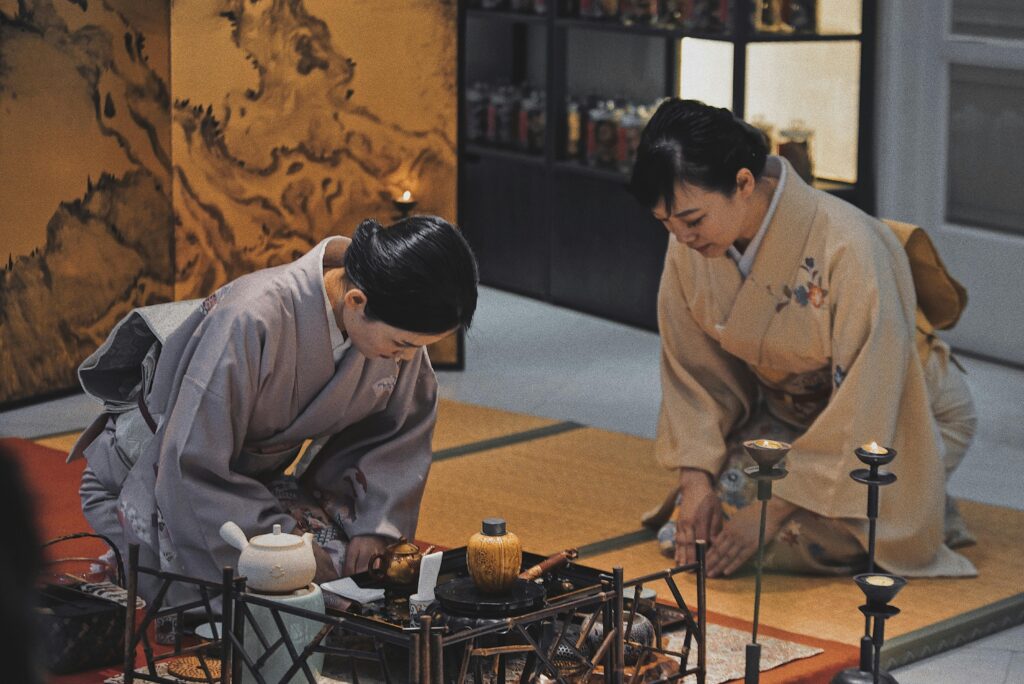
Iemoto is the hereditary grand master who leads a school of traditional Japanese art and holds supreme authority over its practices. The title usually passes through a family line or formal adoption, and its holder preserves inherited teachings, issues teaching licenses, and serves as final arbiter within the school.
Defining the Iemoto Title
The term iemoto (家元) literally translates to “family foundation” in Japanese. It refers to the Grand Master who leads a traditional Japanese art school, including tea ceremony schools where matcha preparation and service form the core practice. The iemoto serves as the supreme authority, inheriting secret traditions and techniques passed down through generations.
This hereditary position carries immense responsibility. The iemoto protects centuries-old traditions, issues teaching licenses, and acts as the final arbiter on all matters concerning their school’s practices. Alternative titles include O-Iemoto, Sōshō, or Ō-sensei, all conveying the elevated status of this role within traditional arts.
Only one iemoto leads a school at any given time. The title typically passes through direct family lines or formal adoption, often accompanied by a hereditary name that connects each generation to the school’s founding lineage.
Historical Development of the Iemoto System
While family-based transmission of secret teachings existed as early as the Heian period (794-1185), the term “iemoto” first appeared in written records during the late 17th century. Initially, it described families holding priestly roles and exclusive knowledge within specific traditions.
The modern application to traditional arts emerged in the mid-18th century. This system reflects deeper Japanese social patterns of ie (household) and dōzoku (extended kinship networks) that structured feudal society. Historian Matsunosuke Nishiyama formalized the concept after World War II, defining how exclusive family control shaped instructor networks and knowledge transmission.
Evolution in Tea Ceremony Context
The iemoto system became particularly significant in tea ceremony following Sen no Rikyū’s codification of wabi-cha style in the 16th century. His descendants established the framework that continues governing major tea schools today. This structure ensured that Rikyū’s philosophy and precise techniques survived intact across centuries of social and political upheaval.
The Three Major Sen Houses
The san-Senke (三千家, “three Sen houses”) represent the most influential iemoto lineages in matcha tea ceremony. These schools descended from Sen no Rikyū’s grandson, Genpaku Sōtan, whose three sons each established separate lines.
The Principal Lineages
- Urasenke (rear Sen house) — The most widely practiced school internationally, known for thick koicha preparation
- Omotesenke (front Sen house) — Distinguished by subtle procedural differences and emphasis on simplicity
- Mushakōjisenke (Mushanokoji Sen house) — The smallest of the three, maintaining highly traditional practices
Each school preserves distinct variations in whisking techniques, bowl handling, and ceremonial procedures. The differences appear subtle to outsiders but carry profound meaning within each tradition. Another lineage, Sakaisenke, disappeared due to lack of successors, while Edosenke represents a non-blood-related school founded by an Omotesenke disciple.
Roles and Responsibilities
The iemoto’s duties extend far beyond ceremonial leadership. This position requires active preservation of secret teachings, techniques, and philosophical principles that define each school’s identity. The Grand Master serves as living embodiment of centuries of accumulated knowledge.
Core Functions
- Issue teaching licenses and certificates to qualified practitioners at various advancement levels
- Authorize ceremonial names (chamei) for advanced students who demonstrate mastery
- Provide personal instruction to the most accomplished practitioners in secret or advanced techniques
- Represent the school publicly and maintain its reputation domestically and internationally
- Make final decisions on interpretations of tradition and acceptable variations in practice
These responsibilities ensure consistency across all branches of a school. When practitioners worldwide prepare matcha according to Urasenke style, they follow procedures ultimately authorized by the current Urasenke iemoto.
Impact on Modern Matcha Practice
The iemoto system profoundly shapes how matcha preparation is taught and practiced today. Licensing requirements create standardized progression paths where students advance through defined stages, each requiring certification from the iemoto or authorized representatives. This structure maintains quality control but can involve substantial costs—advanced licenses may cost several million yen.
For matcha consumers and practitioners outside Japan, the iemoto system ensures authenticity. When you learn from a licensed instructor, you receive teachings directly traceable to centuries-old lineages. This connection provides confidence that techniques, etiquette, and philosophical understanding remain faithful to historical practice.
Preservation Versus Accessibility
The hierarchical structure excels at preserving tradition but faces criticism for rigidity. Some view the system as expensive, nepotistic, and overly authoritarian. Alternative movements have emerged promoting more democratic tea education outside traditional iemoto control.
Despite these tensions, the system remains the primary mechanism preserving authentic tea ceremony. The iemoto’s authority prevents drift from established forms while allowing gradual, considered evolution. This balance explains why 400-year-old practices remain vibrant and relevant in contemporary matcha culture.
Relevance for Matcha Enthusiasts
Understanding the iemoto system helps matcha consumers appreciate the depth behind ceremonial preparation. When purchasing ceremonial grade matcha, you’re accessing tea cultivated and processed according to standards refined under iemoto guidance across generations.
For those pursuing formal tea study, recognizing the iemoto structure clarifies advancement pathways and credential significance. A teaching license from an established school carries weight precisely because it represents approval from an unbroken lineage of masters. This system connects modern practitioners to Sen no Rikyū himself through direct transmission of knowledge.
Even casual matcha drinkers benefit from this preservation system. The specific temperatures, whisking patterns, and preparation sequences that create perfect froth and balanced flavor weren’t discovered randomly—they represent centuries of refinement protected by the iemoto system.
An iemoto is the hereditary grand master who leads a school of traditional Japanese art, including tea ceremony schools. The iemoto holds supreme authority over the school’s practices, inherits its teachings and techniques, protects its traditions, issues teaching licenses, and makes final decisions about interpretations of the school’s practices.
The Japanese term iemoto literally means “family foundation.” As a title, it identifies the grand master who leads a traditional art school. In tea ceremony, that leadership encompasses inherited knowledge and authority over the school’s practices, including the preservation of teachings, licensing of instructors, and interpretation of established tradition.
Only one iemoto leads a school at any given time. The position commonly passes to a successor through a direct family line or through formal adoption. Succession may also include a hereditary name linking the new title holder to the school’s founding lineage, preserving continuity in its leadership and inherited authority.
An iemoto preserves a school’s secret teachings, techniques, and philosophical principles. The role includes issuing teaching licenses and certificates, authorizing ceremonial names for advanced students, instructing accomplished practitioners, representing the school publicly, maintaining its reputation, and making final decisions about interpretations of tradition and acceptable variations in practice.
The three major Sen houses, collectively called san-Senke, are Urasenke, Omotesenke, and Mushakōjisenke. They descend from Sen no Rikyū’s grandson, Genpaku Sōtan, through three separate family lines established by his sons. Each school preserves its own variations in whisking, bowl handling, and other ceremonial procedures.