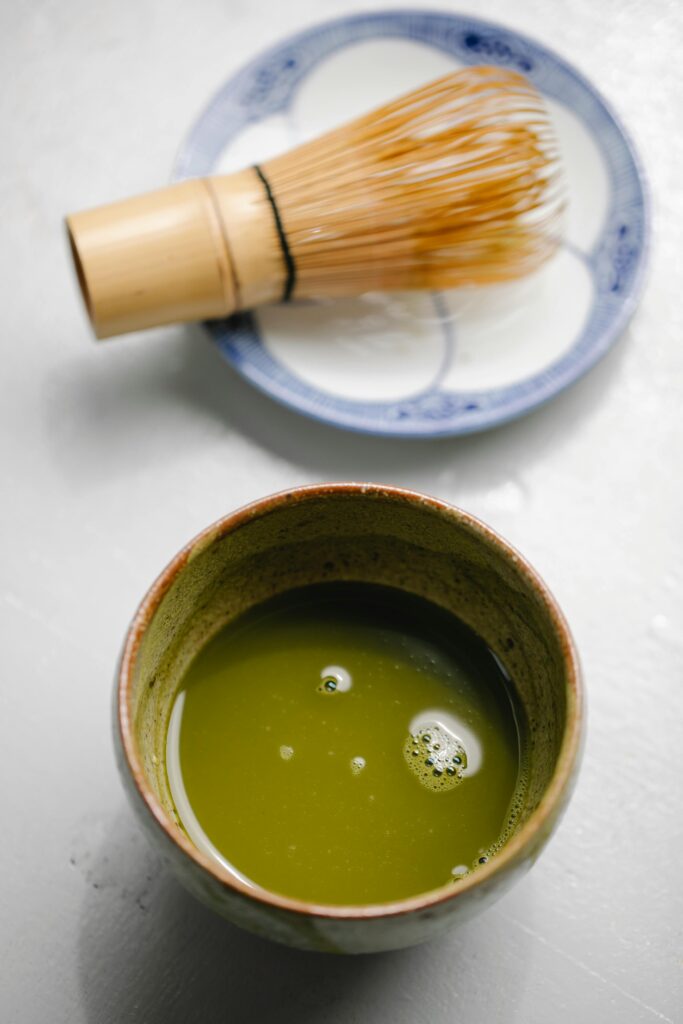
Usucha is a light-bodied preparation of powdered green tea, distinguished from thick koicha by its fluid consistency and fine, uniform foam. It is made by briskly whisking tea with a chasen in rapid zigzag strokes, incorporating air until the surface appears dense, smooth, and free of large bubbles.
Mastering the Whisking Technique for Perfect Usucha
The whisking method distinguishes usucha preparation from koicha’s gentle kneading. Hold the chasen at a slight angle and move it briskly using primarily wrist motion, creating rapid “W” or “M” patterns across the bowl’s surface. This vigorous action incorporates air into the mixture, producing the characteristic fine foam that defines well-prepared usucha.
The whisking duration typically spans 15-20 seconds of continuous motion. Speed matters more than force—rapid, controlled movements create smaller bubbles than slow, heavy-handed whisking. The goal is achieving uniform foam coverage without large bubbles breaking the surface. When properly executed, the foam should resemble microfoam in a well-made cappuccino: dense, creamy, and composed of tiny bubbles.
Whisking Motion: Avoid circular stirring patterns that break foam structure—straight-line zigzag motions maintain bubble integrity throughout the bowl.
Professional tea practitioners often lift the whisk slightly during the final seconds, whisking only the surface layer to refine foam texture. This technique creates an especially smooth finish. The whisk should never scrape the bowl’s bottom forcefully, as this can damage both the chasen and the bowl’s glaze over time.
Achieving the Ideal Texture and Consistency
Perfect usucha exhibits bright emerald color topped with fine, uniform foam. The texture should feel smooth and creamy on the palate without any grittiness from undissolved powder. Light body distinguishes it from koicha’s syrupy thickness—usucha flows easily when the bowl is tilted, while maintaining enough substance to carry complex flavors.
The foam layer serves multiple functions beyond aesthetics. It indicates proper preparation technique and helps preserve temperature while moderating the first sip’s intensity. Quality foam consists of countless microscopic bubbles creating velvety texture rather than large, unstable bubbles that quickly dissipate. This microfoam should persist throughout drinking, gradually thinning but never completely disappearing before the bowl empties.
Consistency problems usually trace to preparation variables. Insufficient whisking produces thin, watery tea lacking body and foam. Excessive whisking can create large bubbles that quickly collapse, leaving flat tea. Temperature extremes also affect texture—too-hot water makes thin tea, while cool water prevents proper suspension of matcha particles.
Bowl Selection and Preparation Setup
Traditional chawan designed for usucha feature wider, deeper profiles than koicha bowls. The rounded interior provides ample space for vigorous whisking without splashing, while smooth glazed surfaces allow the chasen to move freely. Bowl diameter typically measures 12-15 centimeters, offering enough room for the whisk to create proper patterns without restriction.
Pre-warming the bowl significantly impacts final tea temperature and texture. Pour hot water into the chawan, let it sit for 30 seconds, then discard and dry thoroughly. This step prevents the cold bowl from cooling the tea too quickly, which can inhibit proper foam formation. Some practitioners also briefly soak the chasen in this warming water, softening the bamboo tines for more effective whisking.
Bowl Characteristics: Flat-bottomed bowls with rounded sides work best—sharp angles interfere with whisking motion and create dead zones where powder collects.
Material choice affects heat retention and aesthetic experience. Ceramic bowls offer excellent thermal properties and traditional appeal. Modern alternatives include glass bowls that showcase the vibrant green color, though they typically retain less heat. Avoid metal bowls, as they can impart metallic flavors and conduct heat too rapidly.
Common Mistakes and How to Avoid Them
The most frequent error involves incorrect water temperature. Water exceeding 80°C extracts excessive bitterness and destroys delicate flavor compounds. Conversely, water below 70°C fails to properly suspend the powder, resulting in gritty texture and poor foam. Invest in a reliable thermometer or practice estimating temperature by observing water behavior—gentle steam indicates appropriate temperature range.
Powder measurement mistakes create imbalanced flavor. Too little matcha produces weak, underwhelming tea lacking characteristic depth. Excess powder overwhelms the palate with bitterness and creates thick consistency inappropriate for usucha. Using a consistent measuring tool—whether traditional chashaku or modern spoon—ensures repeatable results. Weight-based measurement (2 grams) provides more accuracy than volume-based approaches.
Failing to sift matcha before preparation causes clumping that no amount of whisking fully resolves. Matcha powder naturally compacts during storage, forming aggregates that resist dispersion in water. A fine-mesh sieve eliminates these clumps, ensuring smooth texture. This step takes seconds but dramatically improves results, especially with older or lower-grade matcha.
Variations and Personal Adjustments
While traditional ratios provide excellent starting points, personal preference justifies modifications. Those preferring stronger flavor can increase matcha to 2.5 grams while maintaining water volume. Conversely, reducing powder to 1.5 grams creates lighter preparation suitable for introducing matcha to newcomers or enjoying multiple servings without caffeine overload.
Water volume adjustments offer another customization avenue. Using 60ml water produces thicker usucha approaching koicha territory but maintaining frothy character. Increasing to 80ml creates more delicate, refreshing preparation ideal for warm weather. These variations remain within usucha’s definition while accommodating different contexts and preferences.
Modern practitioners sometimes incorporate additional ingredients without abandoning usucha’s essential character. A small amount of warm honey stirred in after whisking adds natural sweetness without masking matcha flavor. Cinnamon or vanilla can provide subtle aromatic complexity. However, additions should enhance rather than overwhelm—usucha’s appeal lies in highlighting matcha’s natural flavor profile.
Serving Traditions and Modern Adaptations
Traditional service presents usucha immediately after preparation, while foam remains optimal. The host rotates the bowl so its most attractive side faces the guest, who receives it with both hands. Before drinking, the guest rotates the bowl to avoid drinking from its front, showing respect for the vessel’s beauty. These formalities create mindful drinking experience even outside formal tea ceremonies.
Contemporary serving embraces flexibility while maintaining core principles. Usucha adapts well to casual settings—morning energy boost, afternoon meditation break, or social gathering beverage. Some practitioners prepare multiple servings sequentially, refining technique through repetition. Others use usucha as base for matcha lattes, adding steamed milk after initial preparation.
The key to successful serving lies in timing—usucha tastes best consumed within minutes of preparation, before temperature drops and foam dissipates. This immediacy encourages present-moment awareness, aligning with tea ceremony philosophy even in modern contexts. Whether following strict traditional protocols or adapting to contemporary lifestyles, usucha offers accessible entry point to authentic matcha experience.
Troubleshooting Texture and Foam Issues
When foam fails to form despite vigorous whisking, several factors may be responsible. Old or low-quality matcha often lacks the fine particle size necessary for proper suspension and foam creation. Ceremonial-grade matcha consistently produces better foam than culinary grades due to superior processing and particle uniformity. Storage conditions also matter—matcha exposed to air, light, or warmth loses foaming properties over time.
Inconsistent foam with large bubbles indicates whisking technique problems. The motion may be too slow, too circular, or lacking the rapid wrist action that creates microfoam. Practice maintaining steady, quick zigzag patterns without pausing. If the chasen itself is worn—with broken or bent tines—it cannot effectively create foam regardless of technique. Quality bamboo whisks require replacement after extended use.
Grainy or gritty texture despite sifting suggests water temperature issues or insufficient whisking duration. Ensure water reaches proper temperature and extend whisking time to 25-30 seconds if needed. Some matcha varieties require slightly more vigorous preparation than others. If problems persist, the powder itself may be too coarse—consider trying different matcha to determine if the issue lies with the tea rather than technique.
Related reading: matcha grades explained.
Usucha is a light-bodied preparation of powdered green tea. Unlike thick koicha, it has a fluid consistency and a surface of fine, uniform foam. It is made by briskly moving a bamboo chasen through the tea in rapid zigzag strokes, incorporating air until the mixture appears smooth and creamy without prominent large bubbles.
Hold the bamboo whisk at a slight angle and use quick wrist movements to trace straight-line W or M patterns through the tea. Whisk rapidly rather than forcefully, avoiding circular stirring and hard contact with the bowl’s bottom. This controlled zigzag motion incorporates air and creates smaller, more uniform bubbles across the surface.
Usucha is typically whisked continuously for 15 to 20 seconds. During that time, use rapid, controlled zigzag strokes to produce a smooth surface of fine bubbles. Speed is more important than heavy pressure because quick wrist movement creates smaller bubbles, while slow or forceful whisking can result in coarse, unstable foam or damage the whisk.
Properly prepared usucha should have a bright green appearance with fine, uniform foam covering the surface. Its body should remain light and fluid rather than syrupy. On the palate, it should feel smooth and creamy without grittiness from undissolved powder. The foam should consist of tiny bubbles rather than large, unstable ones.
Large or inconsistent bubbles usually point to whisking that is too slow, too circular, or insufficiently driven by rapid wrist movement. Maintain quick, steady zigzag strokes without pausing. Also inspect the chasen: broken or bent tines can prevent it from producing fine foam. A worn bamboo whisk may need to be replaced before technique changes can help.